Wednesday, 10 September 2014

Tomoko Fuse in Bangalore!


Yes, It is true! Tomoko Fuse is going to be in Bangalore soon!

In July, someone from Japan Foundation called me and said that they were bringing the renowned Origami designer Tomoko Fuse to India. They wanted to know if it made sense to do an Origami workshop in Bangalore. Though I was a bit hesitant because there is not even an Origami club or society in Bangalore, I thought that this was one way to bring together everyone who is interested. So we decided to go ahead, and the event is beginning to take shape.

A few members of Origami Mitra (from Mumbai), came to know of the event, and have planned to fly in to attend the event. Now I am becoming more confident that we will have enough people for the demo and workshop, and that the event will be a success.

Ant-Lion Kusudama (30 units) by Tomoko Fuse

The event is being organized by Japan Foundation, and I helped them to find a venue suitable for an Origami workshop. I, Mr Sastry from Kolar (a veteran Origami practitioner) and a few others have been planning and coordinating the preparations.

As it says on the invitation above, please contact me at art.folding@gmail.com if you are interested in attending. We are keeping the event open, but we would like the participants to be reasonably competent in Origami. We definitely want to do something more advanced that the 'beginner Origami' workshop I have been conducting for the last 5 years in Bangalore!

Tomoko Fuse

Tomoko Fuse is well known for her variety of modular boxes. The spiral is also a consistent theme in her models. She has also designed masks and many other
beautiful Geometric models.

Here are some of her models folded by me.

Nautilus

Snail


Espiral

5-pointed Spiral

Double-locked Spiral Box

Wednesday, 19 March 2014

Japan Habba 2014

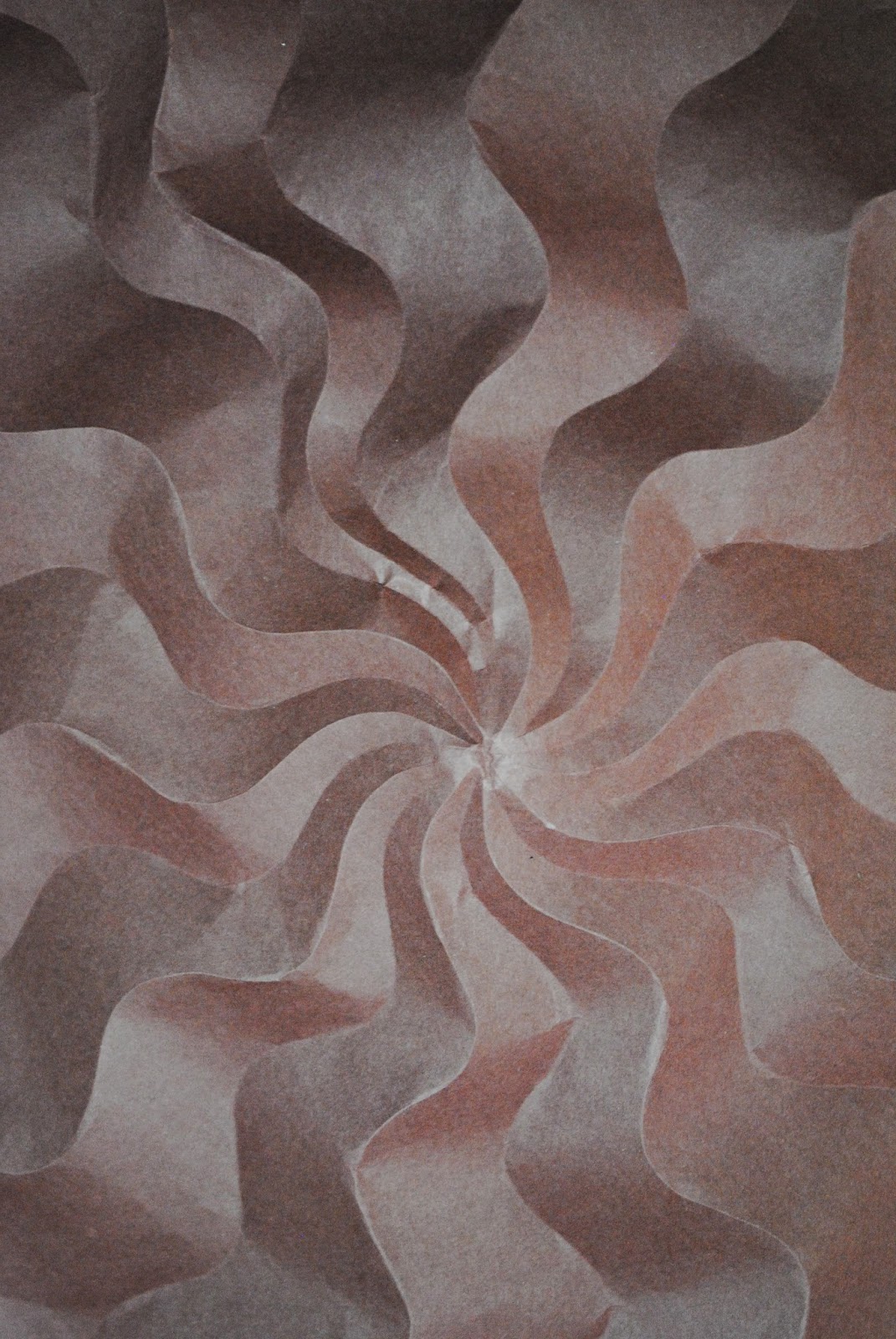
Ripples (Andrew Hudson?)


Japan Habba 2014

Japan Habba is the annual cultural festival of the Japanese community in Bangalore (or Bengaluru). This year, the Habba was held at Mount Carmel College, unlike the last two years.
With Mr Sastry of Kolar.
I, Mr Sivasankara Sastry, and SM Huseini were invited to exhibit our skills at the Japan Habba. Mr Huseini is a Kirigami expert, and he was demonstrating making a simple paper mask.

Mt Sastry, who is employed in a bank in Kolar, is a man of multiple talents. He has been dabbling in Origami and Kirigami for more than 30 years. His current passion is to use Origami to teach mathematical concepts. These days he is continually traveling across the country, conducting workshops for teachers, etc. He was exhibiting his life-size kirigami insects cut from ordinary magazine paper. These insects look so life-like because of the intricate details and choice of appropriate colour. I decided to make a few models using curved folds as the theme.

While it had no particular connection to Origami, the Conway Pencil Model (seen
in the above picture with Mr Sastry), made from 72 red and black Nataraj pencils, was a major attraction at my stall. The other item that created a lot of interest was the very simple 'Ripples' model, which is simply a series of identical curved folds radiating out from the center.

Mr and Mrs Hata stop by my stall
There were a couple of other Origami stalls too. One was by Nikhil Sharma, and Engineering student, who displayed a fabulous array of dragons, birds, animals, modular objects, and so on. The other one was by a very young school student.

Apart from the paper craft, I really enjoyed the Taiko drums in the huge auditorium at Mount Carmel college.

There was also the usual Tea Ceremony, kimono wearing, etc. and a lot of stalls selling Japanese stuff such as Manga comics, food, and even Chef's knives! So now we have wait for one more year for Japan Habba 2015!

Energetic Taiko performance at Japan Habba


Vases using curved folds

Inside the golden yellow vase

Vases using curved folds

For this year's Japan Habba, I decided to choose curved folds as my theme. It has been on my to-do list for sometime to create vases and other objects using pleating, based on a tutorial provided by Rebecca Gieseking.

My version of the Daruma Doll
The beauty of this method is that you can choose any form or profile that you want to create. Then you draw the profile on a piece of graph paper,  do the calculations required to achieve the form, and then transfer the calculations and the resulting curved folds to your large sheet of paper.

Usually it helps to score the paper when you are doing curved folds, so I use some object with a sharp tip. Of course, make sure that it is not too sharp, or it will cut through the paper!

Here are a couple of models I created using this method, including this 'Daruma' doll.

Golden Yellow Vase

Wine Goblet


But the one that was most appreciated at the Japan Habba was this wine goblet.Even I admit that this one came out nicely!

Here are some more examples of curved folds and the amazing variety of shapes one can create using them.

Huffman Tower
Concentric Circles with a hole hut at the center, allowing the paper to take a variety of amazing shapes


Spherical Origami nÂș14 – Jun Mitani

Monday, 4 March 2013

Beginner Workshop in Malleswaram, Japan Habba 2013


At Japan Habba, along with Mr VSS Sastry


Japan Habba 2013

Mr Sastry's Kirigami Masks
This year the Habba organizers had given a large space for the Origami display, which was shared with Mr VSS Sastry's Kirigami masks (depicting Japanese mythological characters), Syed Hoseini's cut-out designs and Rashmi's miniature paper models. We all owe thanks to Mr Sastry for working with the organizers to provide us the dedicated space.

Sharadhi Shetty's Origami Ocean display


There were a couple of other Origami displays in the upper gallery, including one where a designer converted many of them into ear-rings and other 'useful' objects.


Article in Deccan Herald's Bangalore edition

Today's Deccan Herald newspaper had an article about my Origami in their local supplement Metro Life. Read it online here. The paper version had a few nice pictures of Chris Palmer's Flower Tower, the Shelf with a variety of small Origami models, Pram by Roberto Gretter, etc.


Beginner Origami workshop in Malleswaram

Date:          Sunday, 10th March, at 11am.
Age:           9 years and above.
Fees:          Rs 150, including paper (to be  paid on that day)
Duration:   90 minutes.
What do you need to bring:  Nothing!

Limited seats!  Book your seat early by sending me an email at art.folding@gmail.com


Saturday, 23 February 2013

Japan Habba 2013 is on this Sunday, Feb 24th

Japan Habba 2013

I will be exhibiting my Origami for the third year running at Japan Habba. The Origami display and the rest of the gaollery is supposed to be open only 10am-12pm, but it will likely be open until later. There will be lots of Japanese cultural activity, including food. Do visit and have fun!


Friday, 21 December 2012

One for the Season

Pesebre - Daniel Naranjo
Pesebre

Pesebre is a Spanish word that means manger. This is a quintessentially minimalist model created by Daniel Naranjo.

Paper: Copy Paper, 10x10cm (Mary and Joseph), 5x5cm (Baby Jesus)
Difficulty: Simple
PDF Diagram: available here.

Pram (Roberto Gretter)

I finally managed to track down the diagrams for this exceptional model. This is my first attempt, with an A4 sheet of copy paper. This obviously needs a much larger sheet of paper of better quality. I will attempt it again in 2013!


Classes in 2013

I plan to hold another beginner workshop in Jaaga in the second half of January 2013. There are a few people around Malleswaram who are interested, so I may start a regular weekly class too. Do let me know if anyone is interested.

Happy New Year to all of you! See you in 2013.

Wednesday, 19 December 2012

Origami Owls


Owls

Of late, I have been trying to fold different kinds of Owls. There is a large variety of Origami Owl designs, and here is a subset of them.


Owl by Beth Johnson

Diagram at http://bethorigami.wordpress.com/art/designs/owl-copy/
Paper: handmade, 20x20xcm


The feathers are obtained by simple pleating in two directions at one corner, and the 3D shape is obtained by folding locks on the inside.


Hex Owl by Beth Johnson

Diagram at http://bethorigami.wordpress.com/art/designs/hex_owl-2/
Difficulty: High.

Similar to the previous one, this is folded from a hexagonal grid. The feathers are made by repeating a tessellation. One needs a large sheet to do these cleanly.


Owl by Davor Vinko

This is a more complicated design, with well designed locks to keep the model in shape. There are variations, such as the open winged model seen at the top.

Diagrams: Multiple crease patterns available here and here, and there is a video as well.


More Owls

There are a lot more of Origami owls out there. You can find some on Flickr, Squidoo, and other places.

Thursday, 22 November 2012

Origami with Quilling strips, inspired by Bamboo

 Just playing with quilling strips


Origami with Quilling strips

Previously I had used quilling strips to make the traditional puffed stars.  When I visited the recent A Hundred Hands annual event, I saw some extremely delicate bamboo jewellery, and it inspired me to try more Origami with these thin, perfectly cut strips of paper.

I learned this new design from the master bamboo weavers at the event. This one is made with four strips of material. The quilling strips are about 10mm wide, but the bamboo piece was done with strips barely 2 mm wide!

And the Quilling paper version
The Bamboo version


And here is another familiar design - the Moravian Star, also made with 4 strips.

There are lots of Origami designs  which can be done with paper strips, and there are whole sites dedicated to it as well, such as the Knotology site!


And here are some more variations that I and my son came up with, using quilling strips, and based on the Bamboo jewellery design.


This one looks just like the bamboo jewellery design, but it 'pops' up!


The image at the top is much more like what 'quilling' is really supposed to be!

And finally, I am now a member of A Hundred Hands, the Handmade Collective. The list of their artist members is here.

Wednesday, 31 October 2012

My first online sale!

Curly Kusudama in progress

In the last two weeks, I sold two of my Origami creations online through ItsHandmade.in, which lets individuals sell their stuff through their website. Initially I was going to ship the model I already had, made by my son, but it was a bit soiled, so I made this Kusudama ball from scratch. It uses 60 squares (10.8cm) of 6 colours, from 12 sheets of Frabriano colour copy paper. The folding time was about 3 hours. The Fedex pickup guy was on the dot, and I had to ask him to come back in a few minutes so that I could pack it in a clean shoebox!


Here is what the end product looked like.


The first item I sold was a Spiral Star (design by Tomoko Fuse), made with 4 sheets of metallic embossed paper.

Here is the link to my online 'shop':


ItsHandMade

This site was launched earlier this year, and they are based in Bangalore. Out of curiosity, I signed up and posted a couple of items, giving them an approximate price, lead time, etc. And 2 weeks ago I was pleasantly surprised to see a mail saying that I had an order! In fact I had almost missed the email as I am used to ignoring the regular updates from the site! And then the second order came, which was delivered yesterday.

I am glad to see a few other Origami items on sale at the site, such as lamps and coasters.

Thursday, 18 October 2012

Origami for Dasara display


Origami for Dasara display


I am back with the blog after a long break. I have been busy teaching a student and making various models for her Dasara display. We have been doing animals such as peacocks, elephants, dogs and rabbits, decorative stuff such as Kusudama (curled, glued, etc.), Borromean triangles, etc.


Borromean Triangles

Boromean triangles have been in use for over a thousand years, and are also known as Odin's Triangles.

It consists of three interlinked triangles (sometimes rings). If any one of the triangles is removed, the other two also get separated. Because of this property, it is used as a symbol of unity and cooperation.


Enneagram

Enneagram or Nonagram is a nine-pointed star. A regular nonagram such as the one shown here is used as a symbol of the Bah'ai faith. It is constructed from three equilateral triangles.
Here is a combination of the Borromean triangles and the regular nonagram!


Back to Jaaga this weekend

I am back at Jaaga, conducting two Beginner workshops in Origami on Friday and Saturday at 5pm. Contact me at art dot folding at gmail dot com if you are interested in attending.

***

Wednesday, 20 June 2012

First Commission for Origami

My First Commission!

Last week was eventful, as I delivered my first order for Origami. A designer saw my poster at Jaaga, and called about using some Origami models as the props for a brochure for children's clothing. So we spent a couple of days researching and finalizing the items, and then I spent three whole days, making a variety of flowers, fish, stars, airplanes, and fans.

The photo shoot happened last week, and now I am looking forward to seeing the brochure in print!


The flowers were mainly simplified Kawasaki roses, and a few Omuta roses, mostly in a variety of shades of pink. I also made a few Kusudama flowers, which need glue :(

The larger, simple stars, which look like starfish, were simple pentagons with mountain/valley folds to give it the three-dimensional shape.


I used some "gateway" paper for the fans, which feels like tracing paper. It is almost impossible to reverse a fold on this paper, but it works alright for some simple models.

While looking for the earlier design of the Omuta rose, I found a new one, in Google books! This one is made from a bird base.

The fish models were simple, based on the windmill base.


The F14 Tomcat airplane, designed by Michael LaFosse, is a lovely design, withe video instructions online. It takes some tweaking to fly, but the folding sequence is really impressive.

Recently I made the Art-Deco Wing, also by LaFosse, and it is one of the best glider designs.


The five-pointed stars were folded from a pentagon. I found this design on a blog without any attribution. This blog itself has lots of nice ideas for pop-up cards.


Article in DNA Bangalore

And to top off the week, there was an article in DNA newspaper about I and my Origami. It was in connection with Origami workshop I did at Atta Galatta, a new bookshop and venue for art/craft in Koramangala. The report carried a couple of nice pictures of my Origami, including the traditional two-colour diagonal pleated bangle (which I made from Malabar Gold mailer envelope), bloxy (by Jo Nakashima) and the Carambola.


Here is the link to the article.

ATTA GALTTA: a new venue for Origami classes!

Atta Galatta is a new bookshop in Koramangala, focusing on regional language books. It has a dedicated space for events related to art and craft, and a bakery too is going to open soon. I have done a couple of Origami sessions, and will be conducting sessions at least once a month here.